
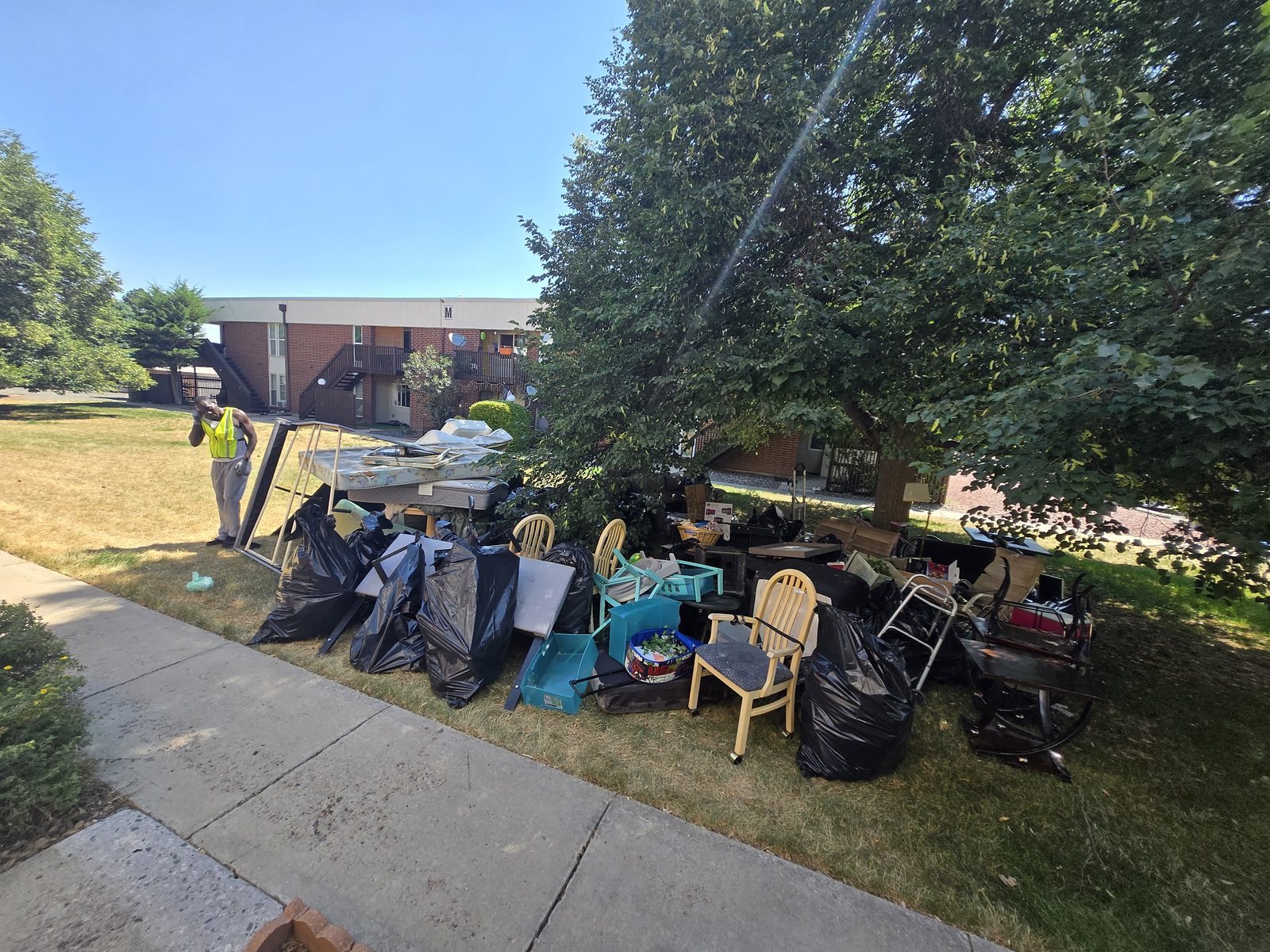
Here is the part almost every guide gets wrong: Colorado has no statute that tells a landlord how to dispose of a tenant's belongings. There is no tidy 15-day procedure written into landlord-tenant law. What exists instead is a set of rules about how you take possession, what you may hold, and what it costs you when you get it wrong.
We run eviction set-outs and tenant cleanouts across the Denver metro most weeks, so this is written from the truck rather than from a statute book. Where the law is genuinely unsettled, we say so.
The short version
- No disposal statute exists. The 15-day notice you have read about lives in C.R.S. 38-20-116, which governs lienholders selling property, not landlords clearing a unit.
- Getting possession wrong is the expensive mistake. Under C.R.S. 38-12-510, an unlawful removal or exclusion exposes you to the tenant's actual damages plus the greater of three times the monthly rent or $5,000, plus their attorney fees.
- After a writ, the sheriff sets the clock — not you. See C.R.S. 13-40-122.
- Your lien does not cover everything. C.R.S. 38-20-102 excludes beds, bedding, clothing, cooking utensils and documents.
What actually counts as abandoned
The test is in C.R.S. 38-12-510. A landlord may only remove or exclude a tenant through court process unless the unit has been abandoned, and the statute lists what that looks like:
- the keys were returned;
- the tenant's personal property has been substantially removed;
- the tenant gave notice; or
- the tenant has been absent for an extended period while rent goes unpaid.
The standard tying those together matters more than the list: the circumstances must be such that a reasonable person would believe the tenant had permanently surrendered possession. A tenant who is three weeks late and has stopped answering the phone has not abandoned the unit if their furniture, clothes and dishes are still in it. That is a tenant who is behind on rent, and the answer there is an eviction filing, not a cleanout.
This is the single most common call we turn down. A landlord wants a unit cleared because the tenant "clearly left," and when we ask what is still inside, the answer is a full apartment.
The number that should slow you down
If you remove or exclude a tenant without either a court order or genuine abandonment, C.R.S. 38-12-510 lets the tenant recover their actual damages plus the greater of three months' rent or $5,000, along with attorney fees and costs. On a $1,800 apartment that is a floor of $5,400 before anyone counts the value of what went in the dumpster.
That figure is why our crews will not start a set-out without either a writ or the landlord's written confirmation of abandonment. It is also why we photograph the unit before anything is touched.
After a writ, the sheriff runs the schedule
Once you have a judgment, C.R.S. 13-40-122 controls the timing, and it is stricter than most landlords expect:
- No writ of restitution issues until 48 hours after judgment.
- The officer may not execute it until at least 10 days after judgment.
- That stretches to at least 30 days if the tenant receives SSI, SSDI, or cash assistance through Colorado Works.
The 30-day provision catches people out. We have had jobs booked off a judgment date that had to move by three weeks once the tenant's benefits came up. If you are scheduling a crew, confirm the execution date with the sheriff's civil division rather than counting days from the courtroom.
Set-outs are also scheduled to the sheriff's clock, not yours. A Brighton job this summer was called for 1:30 on a Friday afternoon; an Aurora one started at 9am on a Monday. The deputy arrives, confirms possession, and the crew works while they are on site.
What we cannot put on the truck
Colorado does give landlords a lien on a tenant's property for unpaid rent under C.R.S. 38-20-102. Most guides stop there. The part that matters operationally is the exclusion list, because the statute specifically carves out:
- pet animals;
- small kitchen appliances and cooking utensils;
- beds and bedding;
- necessary wearing apparel;
- personal and business records and documents; and
- the personal effects of the tenant and their household.
Read that as a loading rule and it changes how a cleanout runs. The beds, the clothes, the kitchen and the paperwork are the categories a lien never reached in the first place. Two further limits sit on top: the lien must be taken by peaceable means, and if the tenant or their representative is present and objects, it is not peaceable. Asserting it in a way that substantially interferes with the tenant's ability to occupy the unit is unlawful, forfeits the lien entirely, and creates a damages claim.
What we set aside on every job
Whatever the paperwork says, some things do not go in the truck without a conversation. Our crews pull these out and photograph them separately:
- identity and immigration documents, birth certificates, passports, titles;
- prescription medication and medical devices;
- photographs, letters, and anything that reads as irreplaceable;
- firearms, which stop the job until the landlord and the sheriff's office agree on handling.
None of that is legal advice. It is what keeps a cleanout from turning into the story a judge hears later.
How a set-out actually runs
Sheriff-supervised set-outs are labour jobs, not truck jobs. Crews run six to ten people because the deputy is on site for a limited window and the work has to fit inside it. A Denver eviction this spring ran across two days by design: day one the crew set the contents out under the sheriff's supervision, day two we came back and hauled whatever the tenant had not collected. That gap is the tenant's opportunity to retrieve their property, and building it in deliberately is cheaper than litigating about it afterwards.
Voluntary move-outs are a different job entirely. An Aurora tenant who left the state gave notice and left a ground-floor apartment half full; that is a scheduled cleanout with no deputy, no writ, and no clock.
Where this leaves you
Because there is no disposal statute, your protection is evidence rather than a procedure. Photograph the unit before anything moves. Keep a written inventory. Note what was set aside and what happened to it. Give the tenant a documented chance to collect. If you assert a lien, keep it off the excluded categories and take it peaceably.
And if the tenant has not clearly surrendered possession, file the eviction. A cleanout that starts too early is the most expensive shortcut available in Colorado landlord-tenant law.
This is how we operate on tenant cleanouts and eviction set-outs in the Denver metro. It is not legal advice, and every unit has its own facts. Confirm your position with a Colorado attorney before disposing of anyone's property.
Need Fast Tenant Cleanout Service?
We help Denver metro property managers clear abandoned property same-day. Eviction cleanups, tenant turnovers, bulk removal. Volume discounts available. Licensed & insured.
Eviction & Tenant Cleanout Services →What we photograph, and why
Because no disposal statute exists, a file is the only thing standing between you and a C.R.S. 38-12-510 claim. Our crews shoot the same sequence on every set-out, and we hand the folder to the landlord:
- Wide shots of every room before anything is touched, timestamps on
- Close-ups of anything that looks like it matters to someone — documents, photo albums, medication, ID, mail
- The lien-excluded categories under C.R.S. 38-20-102 as we find them: beds and bedding, clothing, cooking utensils, records
- Whatever we set aside, and where we left it
- Wide shots of the cleared unit
Keep your own written inventory alongside it, plus any message where you offered the tenant a chance to collect. That is the record that matters if this is argued later.
Questions landlords actually ask us
How long does a landlord have to keep a tenant's belongings in Colorado?
Colorado has no statute setting a storage period for a residential tenant's abandoned belongings. The commonly cited 15-day notice comes from C.R.S. 38-20-116, which governs lienholders selling property rather than landlords clearing a unit. Because no fixed period is written into landlord-tenant law, documentation and a genuine opportunity for the tenant to collect are what protect the landlord.
When is a tenant's property considered abandoned in Colorado?
C.R.S. 38-12-510 sets the test: returned keys, substantial removal of the tenant's property, notice from the tenant, or extended absence while rent goes unpaid, in circumstances where a reasonable person would believe the tenant permanently surrendered possession. A tenant who is behind on rent but whose furniture and clothing remain in the unit has not abandoned it.
What happens if a landlord throws away a tenant's belongings too early?
Under C.R.S. 38-12-510, an unlawful removal or exclusion exposes the landlord to the tenant's actual damages plus the greater of three times the monthly rent or $5,000, together with the tenant's attorney fees and costs.
Can a Colorado landlord keep a tenant's property for unpaid rent?
C.R.S. 38-20-102 gives a landlord a lien for unpaid rent, but it excludes pet animals, small kitchen appliances, cooking utensils, beds and bedding, necessary wearing apparel, personal and business records and documents, and personal effects. The lien must be taken by peaceable means; if the tenant or their representative objects it is not peaceable, and asserting it so as to substantially interfere with occupancy forfeits the lien and creates a damages claim.
How soon after an eviction judgment can the sheriff remove a tenant in Colorado?
Under C.R.S. 13-40-122 no writ of restitution issues until 48 hours after judgment, and the officer may not execute it until at least 10 days after judgment. That extends to at least 30 days where the tenant receives SSI, SSDI, or cash assistance through Colorado Works.
Disclaimer: this is how we operate on tenant cleanouts in the Denver metro, not legal advice. Confirm your position with a licensed Colorado attorney before disposing of anyone’s property.